 |
 Cystic
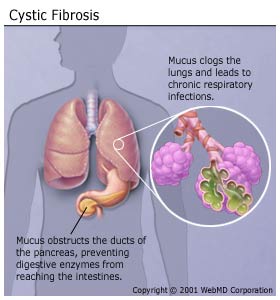
Fibrosis (CF) is a life-shortening genetic disease that affects
the body systems where mucus exists (lungs, digestive system,
sinuses and reproductive organs). Those who live with CF have
abnormally thick, sticky mucus that causes recurring lung infections
and progressive lung deterioration. CF can also impair digestion,
causing an infant to suffer from “failure to thrive,” where
nutrients from food cannot be broken down, causing the child to grow
slowly, be frail and small. Cystic
Fibrosis (CF) is a life-shortening genetic disease that affects
the body systems where mucus exists (lungs, digestive system,
sinuses and reproductive organs). Those who live with CF have
abnormally thick, sticky mucus that causes recurring lung infections
and progressive lung deterioration. CF can also impair digestion,
causing an infant to suffer from “failure to thrive,” where
nutrients from food cannot be broken down, causing the child to grow
slowly, be frail and small.One in every 31 Americans carries the defective, recessive CF gene. Both parents must pass the defective gene to their offspring in order for a child to be born with CF. If both parents are carriers, the odds are 1 in 4 that a child will be born with CF, 1 in 2 that he will be a carrier. Currently there is no cure for CF, but there is great hope as much has been learned about the cause and progression of the disease.
Broadening our understanding of CF helps improve the quality of life for people who live with it. In 1985, the median life expectancy for someone with CF was 25.6 years. Today it is 36.8 years. As an interesting perspective, in the last four years alone, we have added more than five years to the median survival age of CF patients. We attribute this improvement in both the length and quality of life for CF patients to the fact that there are now more CF therapies than ever before—largely developed with support from CFF—and even more on the horizon. For more information on CF and the latest in treatment advances and hope for those whose lives it touches, visit the website for the Cystic Fibrosis Foundation. |
| © 2008 Cystic Fibrosis
Foundation. All rights reserved. design | Creative Types, Jacksonville, Fla. |
 In 1989, researchers supported by
the Cystic Fibrosis Foundation (CFF) discovered the defective gene
responsible for CF. Once found, other genetic diseases were able to
find their gene – the next was found only nine days later. Today,
all genetic diseases know where their gene is, and genetic testing
is routinely available for families at risk of genetic
abnormalities. Many states, including Florida, recommend all
pregnant women have genetic screening for several genetic diseases,
including CF.
In 1989, researchers supported by
the Cystic Fibrosis Foundation (CFF) discovered the defective gene
responsible for CF. Once found, other genetic diseases were able to
find their gene – the next was found only nine days later. Today,
all genetic diseases know where their gene is, and genetic testing
is routinely available for families at risk of genetic
abnormalities. Many states, including Florida, recommend all
pregnant women have genetic screening for several genetic diseases,
including CF.